| Allan Duffin
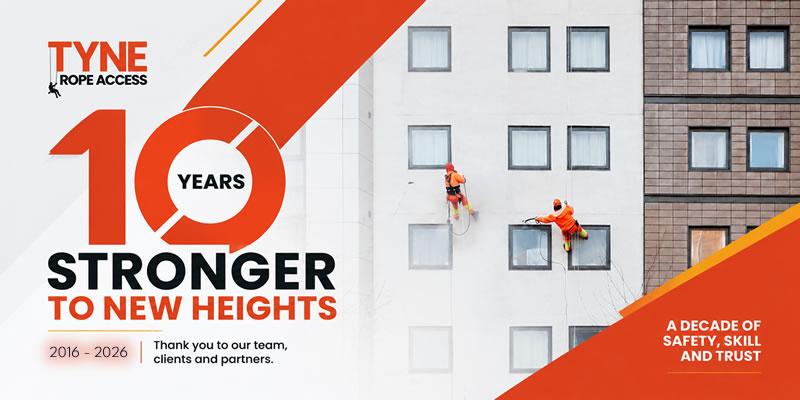
July 2026 marks ten years since Tyne Rope Access began. In that time, we've completed hundreds of jobs across the UK, Ireland, and offshore in the North Sea, from bird control and industrial coatings to emergency repairs in challenging locations. The most useful thing we've gained is better judgement about how to approach the work.
Knowing when to say “not like that”
Early in a business, the instinct can be to say yes straight away and work out the awkward details afterwards. Experience teaches you to pause. Sometimes the useful answer is “not like that”: the proposed access method needs another look, the timeframe is unrealistic, or the scope cannot be carried out safely as described.
For a client, that conversation is best had before a team arrives on site. It gives everyone the chance to agree a workable approach, understand the constraints and plan the job around them. Confidence comes from knowing which questions to ask, as well as knowing how to do the work.
Choosing access to suit the job
Tyne Rope Access was built around rope-access capability. A decade of using it has reinforced the need to judge where it fits. Depending on the site and the task, the practical answer could be rope access, a MEWP, scaffolding, a PASMA tower, ladders where appropriate, or a combination of methods.
The decision starts with the work itself. Getting someone into position is only part of the job: they still need to use tools, handle materials and complete the task properly. An access method has to support that work, suit the building and make practical use of the time available.
What a site assessment needs to uncover
A specification or photograph can make a job look straightforward. On site, building geometry, ground conditions, possible anchor locations, fragile areas and obstructions can change the approach. Other contractors and the movement of pedestrians or building users also need to be considered, alongside rescue arrangements.
Our offshore ballast tank repair work is one example of the range of environments we have worked in. Across that range, experience helps us recognise what needs checking before committing to a setup. It also helps us recognise when new information means the plan needs to change.
Learning from the awkward jobs
The jobs that teach the most are often the ones with an unexpected constraint or a problem that was hidden until work began. Those lessons should carry forward into better site questions, clearer planning and more useful systems for the next job.
Our team, clients and everyone who has trusted us with their projects have made these ten years possible. That trust is a reason to keep thinking carefully about each job, however familiar it first appears.
Ten years hasn't changed what we do. It's changed how carefully we think before we do it.